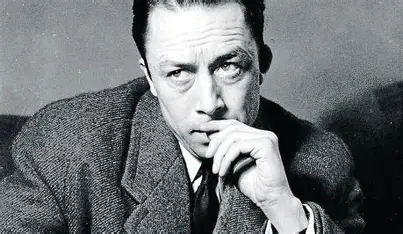
The only way to deal with an unfree world is to become so absolutely free that your very existence is an act of rebellion.
At some point in most professional lives, there is a moment of sudden, unsettling clarity.
It arrives not in crisis but in the middle of something ordinary — a Monday morning commute, a performance review, a meeting that is functionally identical to the one before it. The clarity is brief and rarely spoken aloud. It is the recognition that the life you are living has been, in large part, designed by someone else. The goals you are chasing were handed to you by an industry, an institution, or a social script assembled before you were old enough to question it.
Most people feel this and say nothing. They return to the meeting. They defer the question to a future version of themselves who will have more time, more security, more permission to ask it properly.
Albert Camus thought this deferral was the central tragedy of modern life. And he had a prescription for it that was more radical than any career pivot or productivity system has ever managed to be.
“The only way to deal with an unfree world is to become so absolutely free that your very existence is an act of rebellion.”
What Camus Was Really Arguing
This line is frequently read as romantic provocation — the philosophical equivalent of a motivational poster for people who want to feel edgy without changing anything. That reading misses the precision underneath the drama.
Camus was not calling for political revolution or the performance of rebellion as aesthetic. He was making a structural argument about the only viable response to a world that is, in a deep and probably permanent sense, organised against genuine individual freedom.
The unfree world he described is not a dystopia. It is the ordinary world — the world of institutional incentives, social expectations, and the soft but constant pressure to want the right things and inhabit the right version of a successful life. The unfreedom is not imposed through force. It is maintained through something more efficient: the individual’s own internalised compliance, so thoroughly absorbed it no longer feels like compliance at all. It feels like preference. It feels like ambition. It feels like who you are.
This is the condition Camus considered most dangerous — not the unfreedom you can see and resist, but the unfreedom you have mistaken for yourself.
His response was not to demand that the world become freer. His response was to locate freedom in the one place no external system can reach: the quality of presence, intentionality, and honest self-authorship you bring to your own existence, regardless of what the surrounding structure is doing.
To become so absolutely free that your very existence is an act of rebellion is not to reject society. It is to live with such deliberate authenticity — such honest alignment between your actual values and your actual choices — that the mere fact of your presence constitutes a refusal of the script. You are not performing the rebellion. You are embodying it, quietly, in every decision about how to spend the finite hours of a life that belongs to nobody but you.
What Existential Psychology Confirms
Self-Determination Theory, developed by Edward Deci and Richard Ryan, identifies autonomy — the experience of genuine volition in your choices — as one of three fundamental psychological needs whose satisfaction predicts wellbeing across cultures and professional contexts. When autonomy is satisfied, people report deeper meaning and stronger intrinsic motivation. When it is thwarted — when choices are made from external pressure or internalised obligation — the result is what Deci and Ryan call controlled motivation: activity that looks like agency from the outside and feels like compliance from the inside.
The professionally successful person living a controlled life is, in Camus’s terms, living in the unfree world’s preferred arrangement. Productive, socially legible, and thoroughly compliant with a set of values they experience as their own precisely because the compliance was so thoroughly achieved.
Research on the false self — the version of yourself constructed to meet external expectations — consistently finds it associated with anxiety, emptiness, and the specific exhaustion that arrives not from overwork but from the sustained effort of being someone you did not choose to be.
This is the psychological cost of the unexamined script. It compounds quietly across years, until the moment of clarity arrives and the question can no longer be deferred.
Three Daily Practices to Start Today
1. The Script Audit
Identify one goal or life structure you are currently pursuing and trace it honestly to its origin.
Not where you think it came from — where it actually came from. The career path chosen because a parent’s approval depended on it. The definition of success borrowed from an industry that benefits from your believing in it. The lifestyle assembled from the aspirations of people whose lives you observed before you had formed your own.
Most inherited goals turn out, on honest examination, to be genuinely yours. But some will not survive the scrutiny. Those that don’t were never yours. Continuing to pursue them is not ambition. It is compliance with a script whose author had interests that were never identical to yours.
2. The One Unchosen Hour
Protect one hour each day from every external claim — professional obligation, social expectation, productive output — and use it exclusively for whatever your actual self, consulted honestly, wants to do with it.
Not what would be good for you. Not what you should be doing. What you actually want — the reading with no career application, the creative work with no audience, the thinking that goes nowhere useful.
Camus believed genuine freedom is not a grand gesture made once. It is a daily practice of small, honest self-determination accumulated across the ordinary hours of an ordinary life. The unchosen hour is where that practice lives — the quiet insistence that some portion of your existence belongs to you rather than to the structure surrounding it.
3. The Values Clarification
Once a month, write answers to three questions without editing toward what sounds good: What do I actually value? What am I living as though I value? Where is the gap between those two lists?
The gap is the unfreedom Camus was describing — the distance between the life you are living and the life you would live if the script were removed.
You will not close it entirely. The unfree world makes genuine demands that cannot all be refused without costs that matter. But seeing the gap clearly is the beginning of the only freedom Camus considered worth having — not freedom from circumstance, but freedom within it: the conscious, deliberate inhabiting of a life you have actually chosen rather than one you simply found yourself in.
The Rebellion That Requires No Audience
Camus was not describing a freedom that needs to be announced or recognised by anyone else to be real.
The most absolute freedom is the quietest kind — the person who has examined their values honestly and arranged their life accordingly. They do not look rebellious from the outside. They look, if anything, unusually settled. Unusually present. Unusually clear about what they are doing and why.
That settledness is the rebellion. The unfree world runs on manufactured desire and borrowed ambition. The person who has stopped — who has asked the question, sat with it honestly, and begun to live from the answer — is doing something the system did not design for and cannot easily accommodate.
Their existence is the act.
That is exactly what Camus meant. And it is entirely available to you — not after the next promotion, not when the circumstances finally improve, not when you have earned the right to ask the question seriously.
Now. In the life you already have.
That is where the rebellion begins
Leave a Reply